
QAIP Training Course
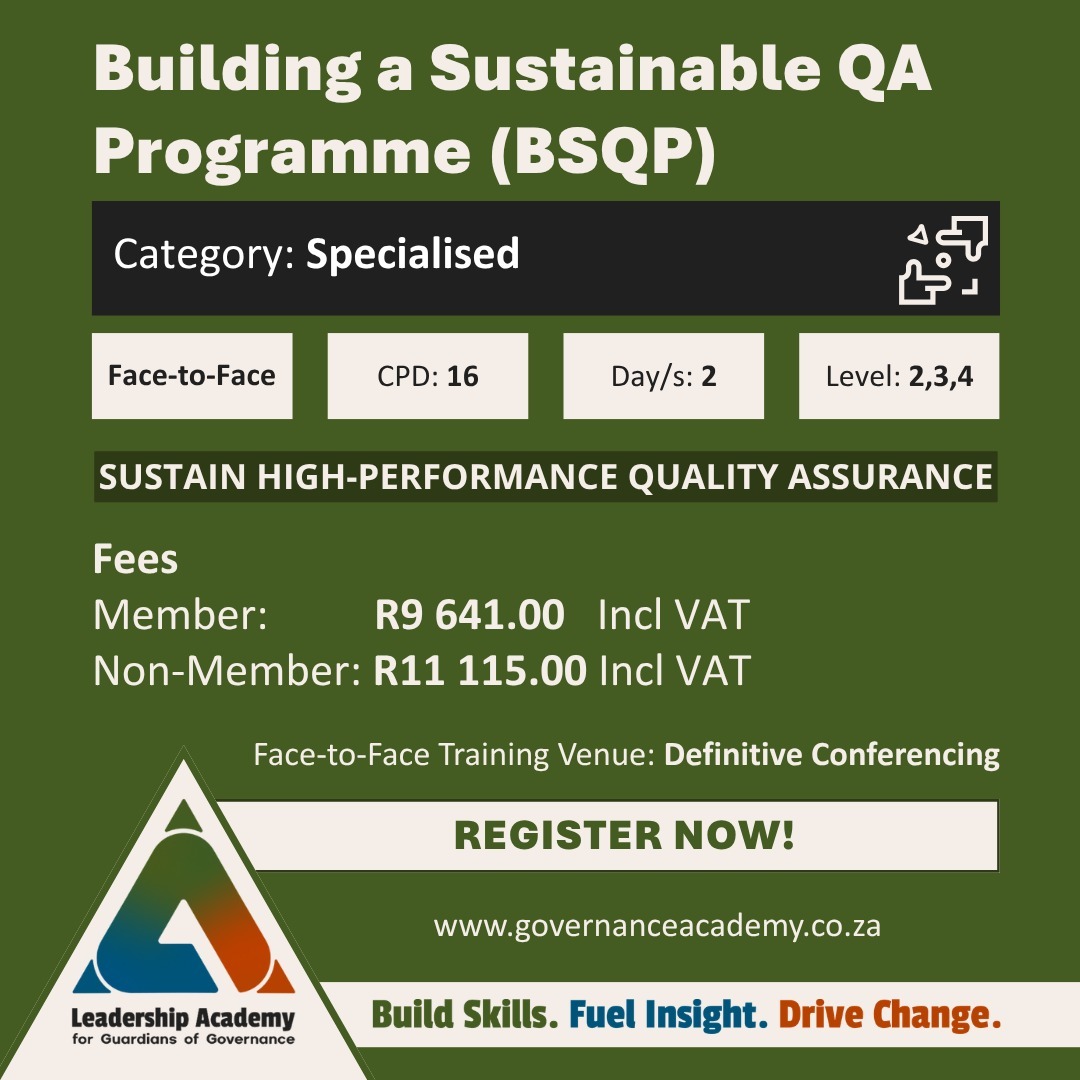
QAIP Training Course: Build an Effective Quality Assurance and Improvement Program
Duration: 2 Days | CPD Hours: 16 | Presented by: Prozilog
Fees
| Excl. VAT | Incl. VAT | |
|---|---|---|
| Member | R8,384.00 | R9,641.00 |
| Non-Member | R9,665.00 | R11,115.00 |
Overview
QAIP training course delegates learn how to build an effective Quality Assurance and Improvement Program for their internal audit activity. In many ways, a strong QAIP works like a total quality management program. It analyses your products and services to confirm they meet stakeholder expectations, evaluates operations for efficiency and effectiveness, and assesses practices against the required standards. Once you establish the program, sustaining it takes leaders who set the right tone in support of quality.
This QAIP training course draws on the quality assessment process flow model and related tools from the recently published Quality Manual. Because our facilitators bring extensive experience in internal audit quality assessment, you gain practical skills you can apply immediately. By the end, you will be able to:
- Apply The IIA’s International Professional Practices Framework (IPPF) quality standards to establish an effective QAIP
- Use the quality assessment process model and its related tools to identify areas of focus for your own QAIP
- Build the two key components of an effective QAIP: ongoing and periodic assessments
- Develop metrics and design reports on the results of your internal audit’s QAIP
- Assess your internal audit activity’s readiness for an external quality assessment
What Is a Quality Assurance and Improvement Program?
A QAIP is a structured program that confirms whether your internal audit activity conforms to the IPPF and operates efficiently and effectively. It combines ongoing monitoring with periodic self-assessments to drive continuous improvement. It is also a mandatory requirement under IIA Standard 1300 — so every internal audit function needs one.
Why Choose This QAIP Training Course?
This QAIP training course gives you more than theory. You leave with the tools, templates, and confidence to design, run, and report on a program that stands up to an external quality assessment. As a result, you can turn a compliance obligation into a genuine driver of audit quality.
Course Content
Pre-assessment of QAIP principles
Quality Standards and Recommended Guidance
- Interpret both mandatory and recommended IPPF guidance on establishing a QAIP
- Discuss key concepts of Standard 1300
- Clarify key elements of the Practice Guide “Quality Assurance and Improvement Program”
Quality Assurance Process Model
- Explain the quality assessment process model and use its related tools to identify areas of focus for a QAIP
- Clarify the purpose of the model’s four segments: Internal Audit Governance, Internal Audit Staff, Internal Audit Management, and Internal Audit Process
- Contrast the purpose and use of the assessment tools — planning guides, surveys, interview guides, and programs
- Identify possible areas of focus for a QAIP
- Highlight key areas of focus based on survey responses
Quality Assurance – Internal Audit Process
- Design an ongoing quality assessment of the internal audit process
- Interpret IPPF guidance related to quality assurance of internal audit processes
- Apply the planning guide to identify and prioritise gaps through a self-assessment
- Clarify the relevant criteria for assessing conformance to IPPF guidance
- Develop the key elements of an ongoing monitoring review process you can implement in your activity
Quality Assurance – Internal Audit Staff
- Design a periodic quality assessment related to internal audit staffing
- Interpret IPPF guidance related to quality assurance of internal audit staffing
- Apply the planning guide to identify and highlight gaps through a self-assessment
- Clarify the relevant criteria for assessing conformance to IPPF guidance
- Develop the key elements of a periodic self-assessment of internal audit staffing
Quality Assurance – Internal Audit Governance
- Design a periodic quality assessment related to internal audit governance
- Interpret IPPF guidance related to quality assurance for governance of the internal audit activity
- Apply the planning guide to identify and highlight gaps through a self-assessment
- Clarify the relevant criteria for assessing conformance to IPPF guidance
Building the Periodic Internal Assessment
- Design a comprehensive periodic internal assessment, including key activities, timing, and resource requirements
- Assess the readiness of the internal audit activity for an external quality assessment
Developing Metrics and Reporting for the QAIP
- Develop metrics and design reports on the results of your internal audit QAIP
- Interpret key concepts from the Practice Guide “Measuring Internal Audit Efficiency and Effectiveness”
- Identify metrics to measure QAIP performance
- Clarify IPPF reporting requirements for the QAIP
- Design reporting options to communicate QAIP results
Who Should Attend
Level 2 — Internal auditors who are already practising and have a basic understanding of the subject.
Level 3 — Supervisory / senior internal auditors with a sound, practical grasp of the fundamentals who manage staff.
Level 4 — Advanced internal auditors with an excellent understanding of the topics, interested in exchanging knowledge with instructors and other participants.
To book, visit: Leadership Academy
View all courses here
Find Us At
ext, Corner of Definitive Lane &, Kruin St, Harmelia, Germiston, Gauteng 1619 South Africa