
Auditing Cyber Security & Information Security NIST & ISO 27002 Course
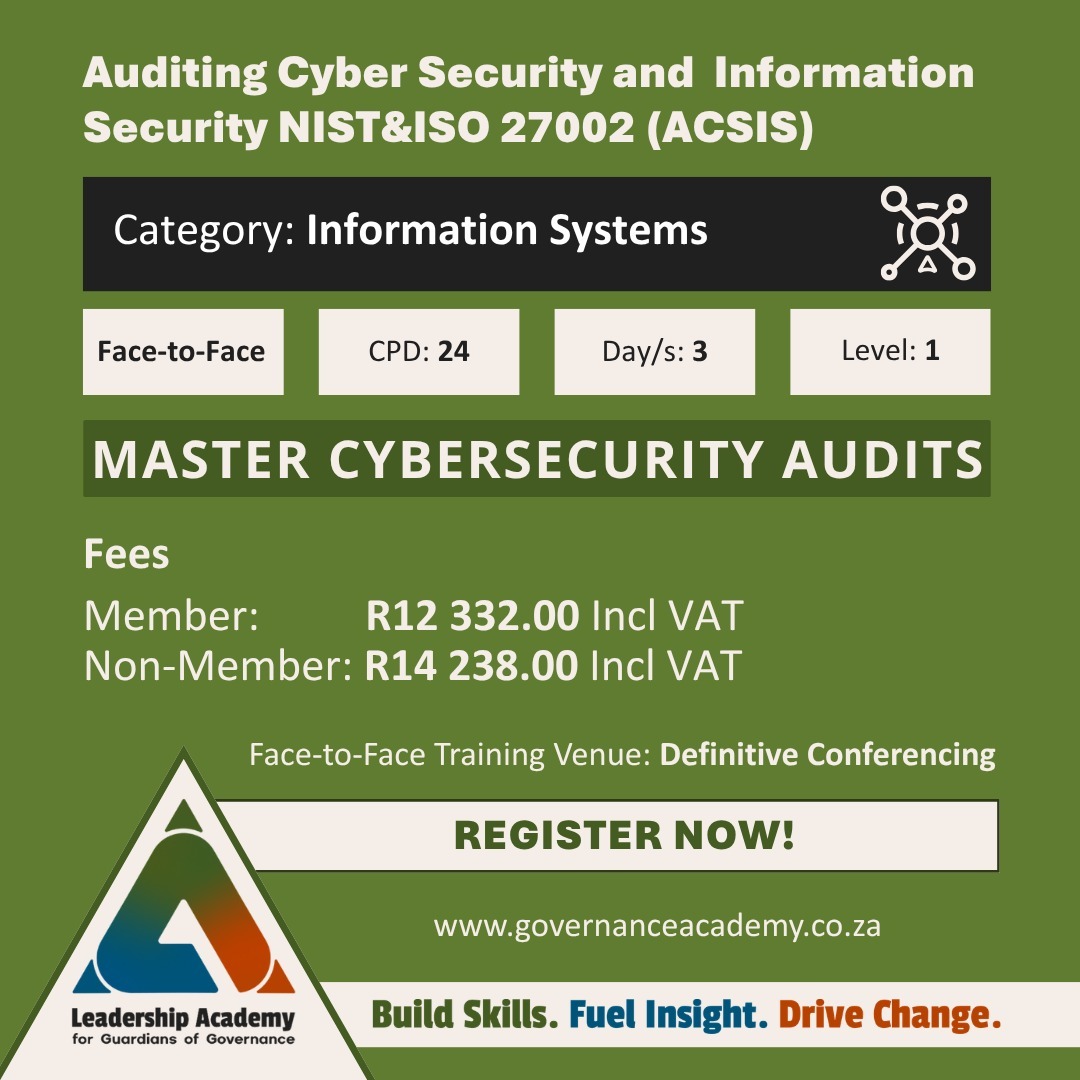
This auditing cybersecurity and information security NIST ISO 27002 course is designed for internal auditors involved in IT audits or those interested in audit activities that require an understanding of how to manage the impact of cybersecurity events on business risks. This auditing cybersecurity and information security NIST ISO 27002 course allows auditors to examine preventive, detective, and corrective controls and how to apply the audit process to a cloud environment.
Attendees will be exposed to the mobile environment and cyber standards, and learn how to audit common security solutions — all through the lens of the NIST Cybersecurity Framework (CSF 2.0) and ISO 27002:2022.
Who Should Attend?
This course is designed for those who need to understand and wish to undertake security audits, including internal auditors involved in IT and cybersecurity audit activities.
Please review the content and course levels before booking to ensure you are attending the right course.
Course Content
Day 1 — Foundations of Cybersecurity Auditing and Governance
Session 1: Course Introduction and Overview of Cybersecurity
Introduction to course objectives, cybersecurity landscape, key business risks, and the role of auditors in managing cybersecurity events. Overview of preventive, detective, and corrective controls. Introduction to NIST Cybersecurity Framework (CSF 2.0) and ISO 27002:2022 as audit references.
Session 2: Cybersecurity Governance and Connections to Networking Concepts
Cybersecurity governance principles, roles and responsibilities (board, management, auditors). NIST CSF Governance function and ISO 27002 organisational controls. Networking fundamentals relevant to audits including architecture, protocols, and common vulnerabilities.
Session 3: Hacking, Cyberwarfare, and Internet Security
Common attack vectors, threat actors, and cyberwarfare implications from an audit lens. Auditing internet-facing controls, firewalls, and perimeter security using NIST/ISO mappings. Audit techniques for identifying weaknesses.
Session 4: Cyber Security Governance Deep Dive and Audit Process
Aligning organisational governance with NIST and ISO 27002. Audit planning, risk assessment, and evidence collection for governance controls. Interactive exercise: mapping governance policies to NIST CSF and ISO 27002 controls. Case study on governance failures.
Day 2 — Technical Controls, Cloud, Mobile, and Encryption Auditing
Session 1: Personal Data Security, Encryption, and Digital Certificates/Identities
Encryption principles, key management, and data protection controls. Digital certificates, PKI, and identity management auditing. Audit procedures for data classification and protection.
Session 2: Wireless Security, Mobile Security, and Cloud Environment Auditing
Wireless and mobile threats and controls including Wi-Fi security, device management, and BYOD. Auditing cloud environments: shared responsibility model, configuration management, and controls using NIST Cloud Computing resources and ISO 27002. Practical audit checklists for IaaS/PaaS/SaaS.
Session 3: Auditing Common Security Solutions
Firewalls, IDS/IPS, endpoint protection, access controls, and vulnerability management. Mapping to NIST Protect/Detect functions and ISO 27002 technical controls. Hands-on exercise: reviewing sample security solution configurations from an audit perspective.
Session 4: Audit Application and Case Studies
Integrating preventive, detective, and corrective controls in audits. Group activity: develop audit test plans for cloud and mobile scenarios, common pitfalls, and best practices.
Day 3 — Incident Response, Forensics, Legal Aspects, and Audit Closure
Session 1: Digital Forensics and Investigations
Forensics principles, evidence handling, and chain of custody in audits. Integrating forensics readiness into security programmes. Audit review of investigation processes.
Session 2: Computer Security Incident Response Teams (CSIRTs) and Incident Management
CSIRT structures and incident response lifecycle using NIST CSF Respond/Recover functions. Auditing incident detection, response, and recovery controls including metrics, reporting, and continual improvement.
Session 3: Legal Framework in South Africa
Overview of key laws: Protection of Personal Information Act (POPIA), Cybercrimes Act, and other relevant regulations. Auditor responsibilities regarding data breaches, privacy, and compliance. Mapping South African requirements to NIST/ISO for integrated audits. Case studies on compliance failures and audit findings.
Session 4: Course Integration, Best Practices, and Assessment
Holistic audit approach combining all elements into a comprehensive cybersecurity audit. Reporting findings, recommendations, and follow-up. Emerging trends, auditor toolkit (checklists and tools), final exercise, Q&A, and certificate of completion.
Topics Covered
- Overview of cybersecurity
- Cybersecurity connections to networking concepts
- Hacking and cyberwarfare
- Internet security
- Personal data security and encryption
- Wireless security and mobile security
- Digital certificates and identities
- Digital forensics and investigations
- Computer Security Incident Response Teams (CSIRTs)
- Legal framework (South Africa — POPIA & Cybercrimes Act)
- Cyber security governance
Contact:
Project Coordinator: CPD and Events
mduduzi@governanceacademy.co.za | 011 609 1761 Ext 403
Find Us At
ext, Corner of Definitive Lane &, Kruin St, Harmelia, Germiston, Gauteng 1619 South Africa