
Fraud Prevention & Detection for Auditors and Accountants
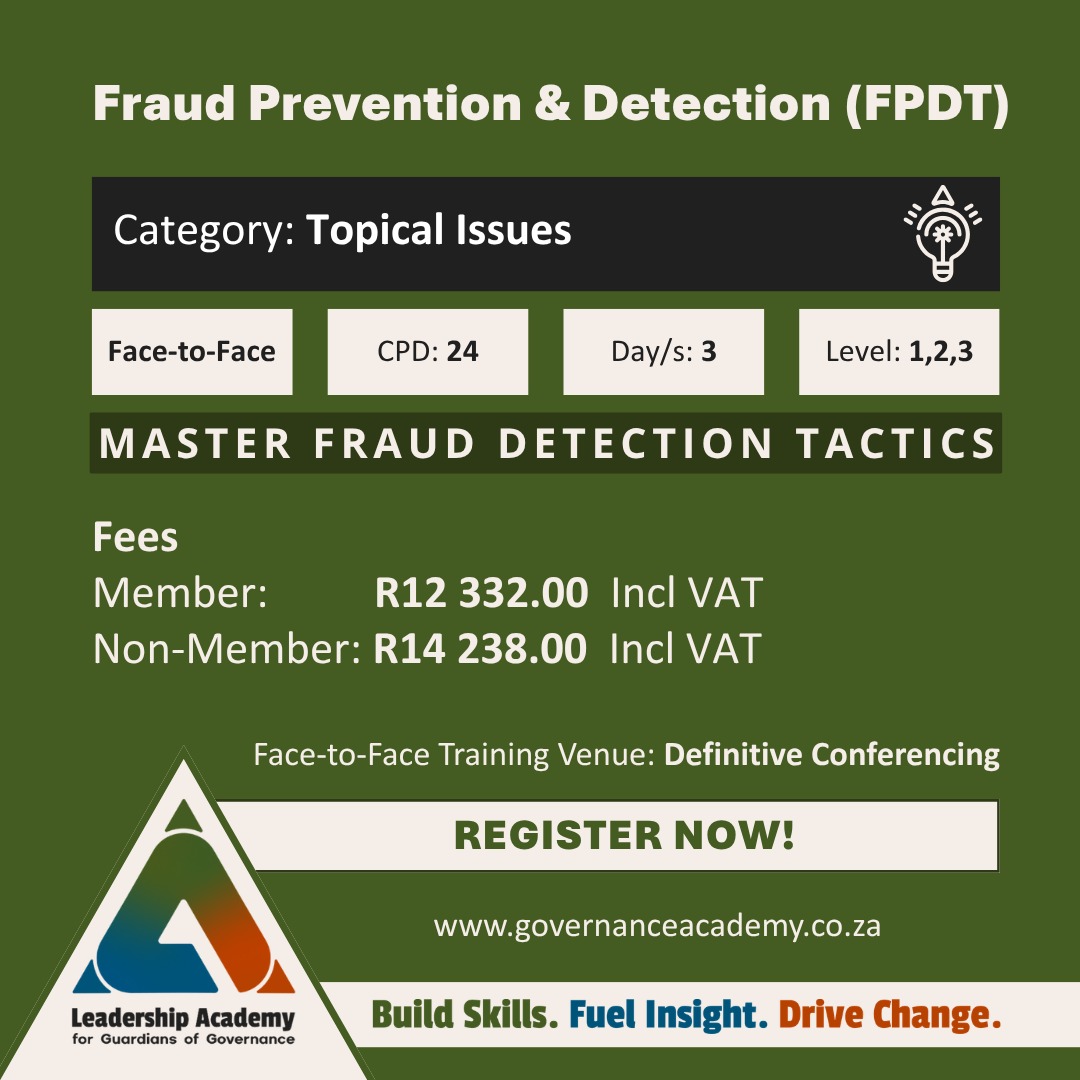
This practical 3-day course equips auditors and accountants with proven techniques in fraud prevention and detection, enabling them to better manage fraud challenges in everyday business. The course explains the various schemes used by employees, managers, directors, and organised criminals to defraud organisations, quantifies the losses from these schemes, and illustrates the human factors that drive fraud.
Who Should Attend?
Level 1 — Entry or introductory level for those requiring a fundamental understanding of the subject.
Level 2 — Internal auditors who are already practicing internal audit and have a basic understanding of the subject.
Level 3 — Supervisory/competent/senior internal auditors: those who already have a sound, practical grasp of the fundamentals of internal auditing and manage staff.
Please review the content and course levels before booking to ensure you are attending the right course.
Course Objectives
- Explain the various schemes used by employees, managers, directors, and organised criminals to defraud organisations
- Quantify the losses from these schemes and scams
- Illustrate the human factors in fraud
- Equip auditors and accountants with proven techniques in fraud prevention and detection to better manage these challenges in everyday business
Course Content
An Overview of Fraud The nature of fraud, why fraud happens, who is involved, how occupational fraud affects your business, profile of a fraudster and criminology theories, and fraud responsibilities according to the IIA Standards.
Corruption Conflicts of interest, bribery (kickbacks and bid rigging), illegal gratuities, economic extortion, and controls to prevent corruption.
Asset Misappropriation (includes case studies) Cash theft schemes, billing schemes, payroll schemes, expense reimbursement schemes, document fraud, procurement fraud, debtors fraud, and controls to prevent asset misappropriation.
Fraudulent Statements Asset/revenue over-statements and understatements, major financial statement fraud case studies, how auditors can assess the risk of fraud in financial reporting, and the fraud risk register.
Computer Fraud Phishing & social engineering (responsible for 80% of all data breaches), Business Email Compromise (BEC), five stages of computer fraud classification, how to train employees to prevent and detect computer fraud, and local examples of BEC emails and spoofed web pages examined for red flags.
The 8-Step Fraud Auditing Process (as per ISA 240)
Reducing Your Fraud Risk Based on the ACFE’s Fraud Prevention Check-up, covering the 10 building blocks of fraud prevention and detection:
- Internal controls
- Fraud risk assessments
- Achieving accountability
- Ethics programmes
- Awareness programmes
- Background checks
- Fraud-related policies
- Data analysis
- Fraud hotlines
- Tone at the top
Attendees can evaluate their own organisation’s 10 building blocks via a high-level gap analysis — a key take-away that provides a foundation from which to audit the fraud risks of their respective organisations. Public sector representatives will also have the 10 building blocks related to National Treasury’s Fraud Prevention Plan, Policy, and Strategy.
Group Case Study Summarising learnings from the course — participants break into groups to answer 16 questions.
The Good, the Bad and the Ugly Three short case studies (global and local) to summarise the course content.
Details
| Date | 29 June – 1 July 2026 |
| Time | Registration from 08:15 |
| Duration | 3 Days |
| CPD Hours | 24 |
| Presenter | Mario Fazekas |
| Online Registration Closes | 29 June 2026 |
| Event Category | CPD / Fraud & Forensics |
Fees:
| Excl. VAT | Incl. VAT | |
|---|---|---|
| Member | R10 724.00 | R12 332.00 |
| Non-Member | R12 381.00 | R14 238.00 |
Contact: Project Coordinator: CPD and Events pontsho@governanceacademy.co.za | 011 609 1761 Ext 411
Find Us At
ext, Corner of Definitive Lane &, Kruin St, Harmelia, Germiston, Gauteng 1619 South Africa